

A Hair-Transplant Surgeon Explains What Really Happens to Your Hair After a Transplant. And The "Month 6" Problem No One Warns You About.
If your transplant looked incredible at month eight but the crown behind it is starting to thin again, you're not imagining it, and it's not too late. Here's what's actually happening, and what the men protecting their results are doing about it.


In twenty years of consultations, the hardest conversation I have isn't with the man deciding whether to get a transplant.
It's with the man who already got one. The man who did everything right, paid five figures, loved his result for the better part of a year, and is now sitting across from me watching it quietly come apart.
And he has no idea why.
So let me explain it the way I'd explain it in my office. Because almost no one tells you this part before you book the surgery, and it's the single most important thing you'll read if you've had one.
01
A Transplant Doesn't Stop Hair Loss. It Relocates Hair.
This is the sentence I wish every patient heard on day one.
When we perform a transplant, we take follicles from the back of your head, the donor zone, where hair is genetically resistant to the hormone (DHT) that drives male-pattern baldness. We move those follicles to the front and top.
Those transplanted grafts are, for the most part, permanent. That's the good news, and it's real.
But here's what the surgery does not touch: the native hair you were born with that's still sitting between and behind those grafts. That hair is on the exact same genetic timeline it was on before you ever walked into the clinic. The male-pattern loss never paused. It was never going to.
So the transplant gives you a beautiful, dense front, while the native hair around it keeps miniaturizing on schedule.
02
The "Island" Effect
Picture it. The transplanted hairline up front is thick. The native crown behind it slowly thins. Month by month, you end up with a patch of strong "new" hair stranded in a receding sea of "old" hair.

In the field we call this an island. A transplant that looks fantastic at year one and oddly patchy by year three. Not because the surgeon did anything wrong, but because nobody protected the native hair around the grafts.
Most men don't see it coming because the first eight to ten months are a honeymoon. The grafts come in. People notice. You feel like yourself again. And then the native loss catches up to you in the mirror under that one harsh bathroom light, and the panic sets in.
03
The "Month 6" Shed Almost No One Warns You About
There's a second thing that blindsides patients, and it's worth naming.

After surgery, the trauma to the scalp can push surrounding native follicles into a temporary resting phase, and they shed. This is called shock loss, and it usually shows up in the first two months. Most clinics at least mention it.
What they mention far less often is the second, slower decline that shows up around month six and beyond, when the underlying male-pattern thinning of the native hair becomes visible again. Patients confuse the two. They think the transplant is failing. Usually it isn't. The grafts are fine. It's the unprotected native hair that's slipping.
Knowing the difference is everything, because the native hair is the part you can still do something about.
04
The Drug Most Surgeons Recommend Next (And Why So Many Men Refuse It)
When a patient asks me, "How do I protect the rest of my hair?" the textbook answer is finasteride. Often for life.
And I'll be honest with you about why a large share of men say no.

Finasteride lowers DHT throughout your entire body, not just your scalp. For most men it's tolerated. But a meaningful minority experience side effects they're not willing to gamble on. A 2018 meta-analysis of 15 randomized trials found a significantly higher rate of sexual dysfunction versus placebo. I've had patients describe brain fog, a flattened libido, feeling "off." Some recover fully when they stop. The fear of not recovering is what makes a lot of men refuse it outright.
Which leaves them stuck: spend five figures on a transplant, then either take a drug they're afraid of, or watch their investment slowly strand itself on an island.
For years, that really was the choice. It isn't anymore. And the reason comes down to a problem most people never think about.
05
The Real Problem Isn't Ingredients. It's Delivery.
Here's something that surprises patients: your scalp is built to keep things out.
The skin barrier blocks the overwhelming majority of anything you apply topically. So a man rubs a serum on his head, sees nothing in six months, and concludes "this stuff doesn't work." Usually the ingredients were fine. They just never reached the dermal papilla, the structure at the base of the follicle that actually controls growth.
This is the quiet reason the bathroom cabinet full of oils, foams and serums fails. Not because the actives are useless. Because almost none of them get in.
Solve delivery, and everything changes.
06
Why Microneedling Quietly Became Standard Aftercare
In dermatology we noticed years ago that controlled micro-channels in the skin did two things at once: they triggered the body's own wound-healing and growth-factor cascade, and they dramatically improved how well topical actives penetrated.
The research backed it up fast. In one well-known randomized study, men who combined microneedling with a topical grew roughly six times more new hair than the topical alone over twelve weeks. Newer 2025 clinical work keeps pointing the same direction. The controlled micro-injury itself is doing a striking amount of the work.
Two things matter enormously here.
Depth. Around 0.5mm is the researched sweet spot for hair. Deep enough to reach the follicular opening, shallow enough to avoid bleeding, scarring or downtime. Longer needles are not "stronger"; on a thinning scalp they're a liability.
Device. A rolling device drags across the scalp at an angle and can snag and snap existing hairs, including, for a transplant patient, the grafts you paid for. A vertical stamp avoids that entirely.
And for transplant patients specifically: this is now something many of us actively recommend post-op to support graft survival and reactivate native follicles, once the scalp has fully healed, generally around 3 to 6 months after surgery. Do not microneedle a freshly operated scalp. Wait until you're cleared.
07
What You Send Through the Channels
Microneedling opens the door. The question is what walks through it. This is where the right actives matter, and where you can get the protective effect without a systemic hormone drug.

Adenosine
A 2024 peer-reviewed study showed adenosine acts on the same androgen-receptor signaling pathway DHT uses to shrink follicles, but it does it locally, at the follicle, without lowering hormones throughout your body the way finasteride does. It's been used as a hair-loss ingredient in Japan for years, and it measurably thickens existing hair shafts, not just sprouts new ones. That thickness matters. Perceived density is as much about how thick each hair is as how many you have.
Copper peptide (GHK-Cu)
Studied for supporting blood-vessel formation and tissue repair around follicles. Exactly the healthy, well-supplied scalp environment that helps both grafts and native hair hold on.
Caffeine & anchoring peptides
Round it out, supporting the growth phase and helping reduce premature shedding.
Local. Drug-free. No effect on your hormones. For the man who refuses finasteride, this is the part that changes the math.
08
Why Most Men Quit Right Before It Works
This is the mistake I see most, so I'll be blunt.
Hair grows on a 90-to-120-day cycle. Almost nothing produces visible regrowth in six weeks. Not minoxidil, not microneedling, not a transplant, not peptides. The first thing to change is shedding: less hair in the drain. Then, around weeks 8 to 12, the baby hairs. Real density takes three to six months of consistency, minimum.
If a brand promises you a new head of hair in 30 days, they're lying to you. Judge this on a biological timeline or don't start.
09
The At-Home Standard That's Emerged
Put it together and the picture is simple. The right system needs three things working at once: a delivery method that actually penetrates the scalp, a multi-active formula at meaningful concentrations, and a routine sustainable enough to honor the 90-day biology of hair.
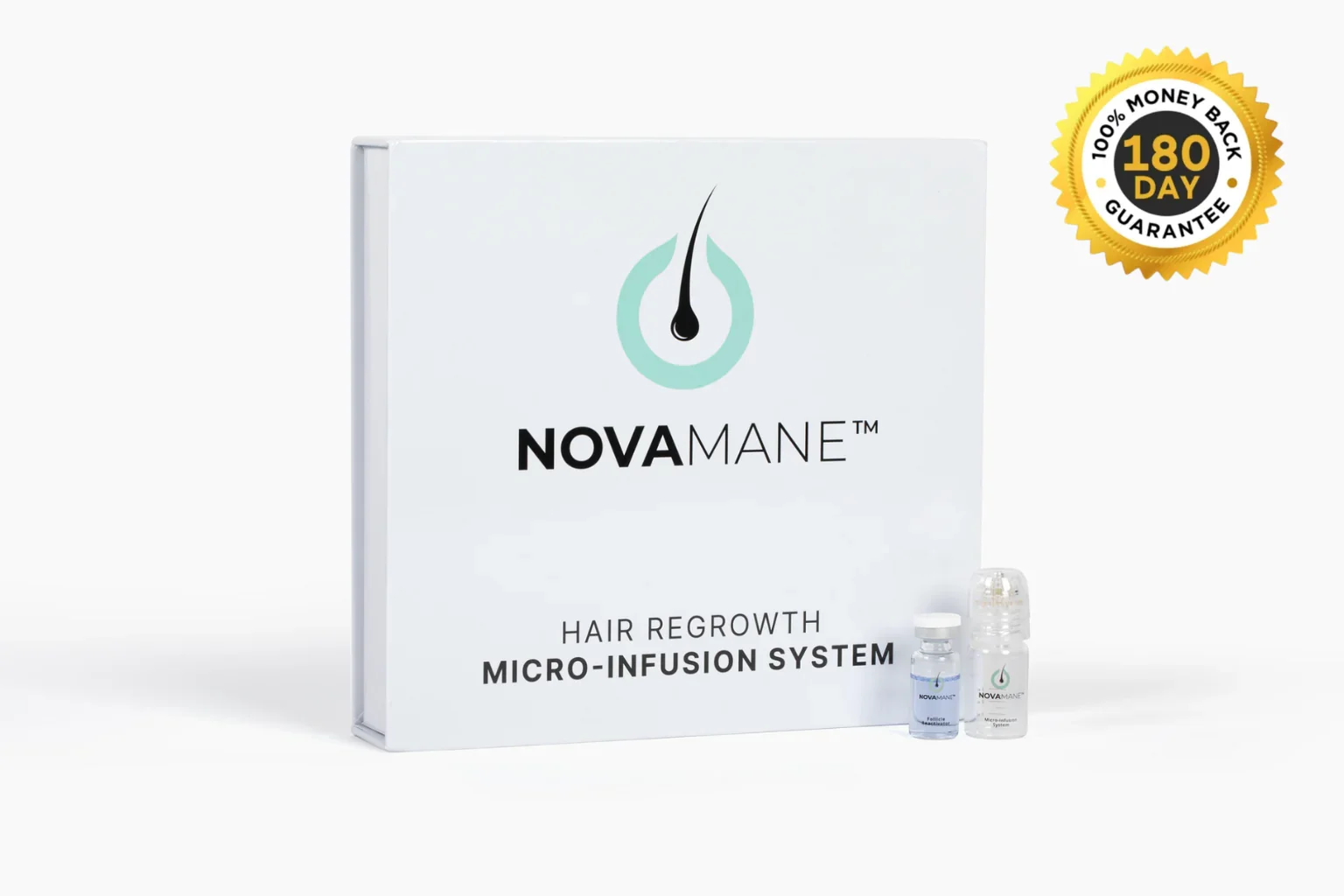
The system I find genuinely well-built for this, and the one I'd point a transplant patient toward, is NovaMane's Hair Regrowth Micro-Infusion System.
It's one of the few at-home setups that pairs a precise 0.5mm vertical micro-infusion stamp with a drug-free peptide serum built specifically to flow through those channels (GHK-Cu, adenosine, caffeine and anchoring peptides) instead of making you buy a random roller from one company and a random serum from another and hope they work together.
No finasteride. No minoxidil. No prescription. No hormones. Just delivery plus the right actives, on your scalp only.
If you've had a transplant: this is how you protect the native hair behind your grafts so your result doesn't turn into an island, without the drug. Start once your surgeon has cleared you, generally 3 to 6 months post-op.
If you're still considering one: running a real drug-free protocol first often buys men years, and if you do go ahead with surgery later, this is exactly what helps it last instead of stranding it.
The surgery moves hair. This protects it.

"I spent thirteen thousand dollars on my transplant. For eight months it was the best money I'd ever spent. By month eleven the crown behind my new hairline was visibly thinning and I realized it was turning into an island. I refused to go back on finasteride. I'd tried it years ago and felt like half a person. This was the third option no one told me about. A year of stamping every other day, and my transplant still looks like a transplant, not an island."
NovaMane is backed by a 180-day money-back guarantee, roughly the honest window it takes to judge hair regrowth. If it doesn't work for you, send it back.
If you spent five figures to get your hair back, the real question isn't whether you can afford to protect it.
It's whether you can afford to watch it strand itself while the only "solution" anyone offered was the pill you already know you won't take.
Protect what you paid for. Drug-free.
The surgery moves hair. This protects it. Start once your surgeon has cleared you, generally 3 to 6 months post-op.
SEE THE NOVAMANE MICRO-INFUSION SYSTEM →180-day money-back guarantee · Drug-free · Non-hormonal · No finasteride, no minoxidil